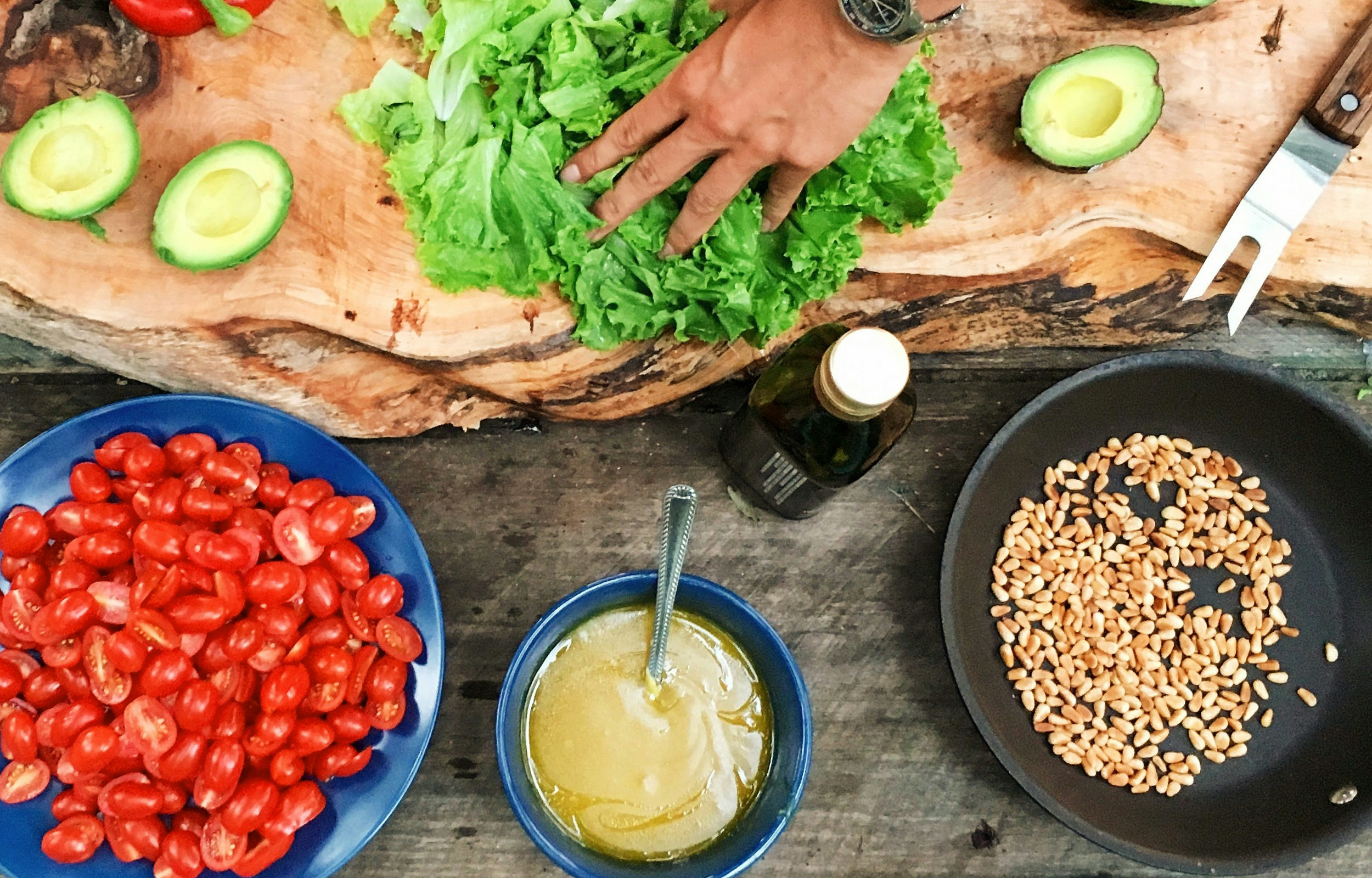
The best meal I can ever remember having was as a teenager in the mountains of Norway. I was camping with my father, my siblings, and our closest family friends. We had caught trout in the lake that morning, smoked them beside the water, and picked chanterelle mushrooms which we fried in a skillet with butter and salt. For dessert, there were wild strawberries and blueberries gathered from the hillside. No restaurant has ever come close. There was nothing sophisticated about it — no technique, no recipe, no planning — just fresh things cooked simply over fire, eaten outside with people you love. That meal has sat somewhere at the back of my mind ever since.
Switching off is, if I am honest, harder for me than I care to admit. The place I find that quality of presence most reliably — the place where my mind genuinely goes quiet — is standing in front of a live fire with a pair of tongs in my hand.
I came to fire cooking through Francis Mallmann, whose Argentine approach to open-flame cooking first made me realise this was something I wanted to pursue seriously (I mean, generally if I pursue something I do it pretty seriously). Being something of a geek, I then went further, acquiring a rig that a friend described as looking like a medieval torture instrument — a multi-level iron frame from which you can hang, grill, smoke, and ember-cook for large numbers of people simultaneously. Two cookbooks have been my companions on this journey: Sarah Glover's “Wild: Adventure Cookbook* and Niklas Ekstedt's “Food from the Fire”. They are very different books, written from very different corners of the world, but together they have shaped the way I think about cooking over flame.
The Rig
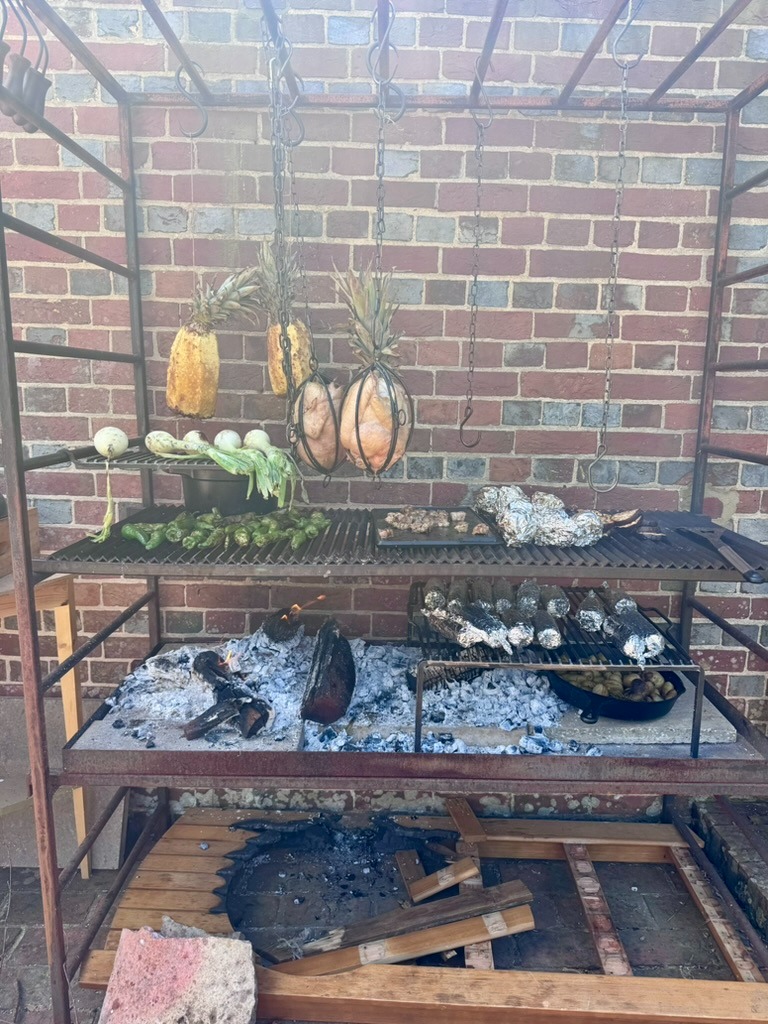
If you want a sense of what fire cooking looks like in practice, I can point you to a recent photograph of my setup — and I think it says more than any recipe could.
The rig is a multi-level iron frame set against a brick wall, and on the day in question it was working at full capacity. Three whole pineapples (brushed with brown sugar and cinnamon) were hanging from the top frame on chains, caramelising slowly in the rising heat. Two whole chickens were suspended in wire baskets beside them, basting in their own juices (and some Salmuera I had made. On the upper grill, a row of Padron peppers was charring alongside foil-wrapped beetroot and some large spring onions. Down in the fire bed — a deep, glowing mass of white ash with flame still licking through — there were corn on the cob buried directly in the coals. A cast iron pan with tallow basted new potatoes sat on the lower grill, doing its quiet work in the residual heat, while fresh logs were stacked below, ready to feed the whole operation.
It sounds chaotic. It is not. Managing all of that simultaneously is actually deeply calming, because it requires complete concentration. You are watching the colour of the coals, adjusting the height of the grill, moving ingredients toward heat or away from it, thinking three moves ahead. There is no room for the day's worries when you are tracking five different heat zones at once. That, I think, is the secret that both of these books understand, even if neither of them says it quite so directly.
There is something else worth mentioning, too. As a grown man, sitting down with other men and simply talking can be surprisingly difficult. But add a fire, a grill, and something cooking, and people gather naturally. The fire gives you something to look at, something to tend, a shared purpose. Conversation flows more easily. Some of my best exchanges with friends have happened standing around that rig, waiting for something to be ready. Part of what drew me to fire cooking was precisely this — a way to be more social, to connect, to create the conditions for the kind of conversation that does not happen in a living room.
“Wild: Adventure Cookbook* — Sarah Glover
Sarah Glover is an Australian chef who grew up eating in the great outdoors, and “Wild” is essentially a love letter to that upbringing. It is a gorgeous book — 340 pages of full-colour photography that transports you to isolated beaches and rugged bush campsites across Australia. A James Beard Award finalist and winner of the 2018 Gourmand World Cookbook Award for Innovation, it has the credentials to match its ambition.
What Glover does brilliantly is make fire cooking feel joyful and slightly reckless in the best possible way. She is not interested in the controlled, clinical approach. She wants you to hang sausages from apple tree branches, bury whole pumpkins in the coals until they are ready to be smashed open and dressed with tahini and pecans, or nail a freshly caught fish to a bark-stripped log and set it beside the embers. Her recipe names alone — "Hot Chicks," "That Be Cray Cray," "Smashing Pumpkin" — tell you everything about the spirit of the book.
Looking at my own grill, I can see Glover's fingerprints everywhere. Those pineapples hanging on chains? That is pure “Wild” thinking — using the rising heat of the fire to slowly transform fruit into something extraordinary, without it ever touching a grill grate. The foil parcels on the upper level are her kind of practical ingenuity too: protecting delicate ingredients while the fiercer heat does its work elsewhere.
Her instructions on reading fire temperature and understanding cooking times are genuinely useful, and her emphasis on using what is available — local ingredients, found branches, saltwater — gives the book an improvisational quality that I find liberating. The recipes are straightforward, often requiring only a handful of ingredients, and her tone is breezy and encouraging. She makes you feel that gourmet outdoor cooking is well within reach, which, once you have done it a few times, it absolutely is.
My only mild caveat is that “Wild” is so deeply rooted in the Australian landscape — kaffir lime leaves, bush lemons, the particular quality of southern hemisphere light in its photographs — that it can occasionally feel a world away from a Hampshire garden in early summer. But that distance is also part of its charm. It is aspirational in the right way.
”Food from the Fire” — Niklas Ekstedt
Niklas Ekstedt's book speaks to a different part of me entirely. I am half Norwegian, and “Food from the Fire” carries the particular atmosphere of the Nordic north — the crackling of birch, the scent of wood smoke, the quiet intensity of cooking that has been done the same way for centuries. When I read it, I am back in those mountains, beside that lake, with the smell of smoked trout in the air.
Ekstedt is a Michelin-starred chef who runs his Stockholm restaurant, EKSTEDT, entirely without electricity or gas — just a fire pit, a wood-fired oven, and a wood stove. He arrived at this philosophy after a period of feeling lost in the world of molecular gastronomy, having trained at El Bulli and The Fat Duck. Returning to the ancient cooking methods of his Jämtland heritage was, by his own account, a kind of homecoming. I find that story quietly moving, and it gives the book a depth of conviction that you can feel in every recipe.
Where Glover is playful, Ekstedt is deliberate. His book is built around what he identifies as the four essential elements of fire cooking: fire, smoke, cast iron, and fat. The recipes that follow — ash-coated lamb, juniper-smoked salmon with homemade sour cream, hot-smoked pork belly brined in fennel and coriander, ember-baked salmon with cucumber and fennel, sautéed chanterelles with apple and thyme — are models of restraint. Those chanterelles, in particular, stopped me in my tracks. Chanterelles fried in butter with apple and thyme is almost exactly what we cooked in Norway all those years ago. Ekstedt has simply given it a name and a page number.
The spicing throughout the book is minimal, because the fire and the smoke are doing the flavouring. The first time I tried one of his recipes and resisted the urge to reach for more seasoning, I understood what he meant. The cast iron pan sitting in the lower grill of my photograph is a direct result of reading this book. Ekstedt is evangelical about cast iron, and rightly so. A shallot seared in a cast iron pan over a wood fire is a different thing entirely from one cooked on a gas hob — sweeter, more complex, with a depth that is hard to explain until you have tasted it. Instead of shallots, I had camembert, grapes and rosemary in one skillet.
I will be honest about one challenge: some of the specific woods and regional Nordic ingredients Ekstedt calls for are not easy to source in Hampshire. Birch is the obvious one — it burns beautifully and imparts a clean, slightly sweet smoke, but it is not something you can pick up at the local garden centre. Although I have found some and am drying it out, I have had to improvise with apple wood and cherry wood, which work wonderfully but are not quite the same. Certain foraged or Scandinavian-specific ingredients require a bit of hunting too. But this is a minor frustration, and the book is generous enough in its technique that adaptation is always possible. Ekstedt himself says he does not expect you to forage for everything, and that a cast iron skillet over a gas flame will produce similar results to many of his dishes. That pragmatism is welcome.
Two Books, One Fire
What I find most interesting, sitting with both books together, is how differently they answer the same question: “why cook over fire?”
For Glover, the answer is adventure — the romance of the outdoors, the freedom of cooking without walls, the pleasure of feeding people in beautiful places. For Ekstedt, the answer is something closer to philosophy — a return to honest, ancestral cooking, a rejection of complexity in favour of depth.
Both answers resonate with me, and on any given cook, I am probably drawing from both. The hanging pineapples are Glover. The cast iron pan and the ember-buried corn are Ekstedt. The whole operation — the multi-zone management, the constant reading of the fire, the deep satisfaction of bringing it all together for a group of friends — is something that neither book quite captures in words, but both of them inspired.
If you are new to fire cooking, I would start with “Wild”. It is accessible, visually inspiring, and it will give you the confidence to try things that seem outlandish until they work. If you have already caught the bug and want to go deeper — to understand the “why” behind the technique, and to connect with something older and quieter — then “Food from the Fire” is the book you need next.
Both are worth a place on your shelf. And both are best read, I would suggest, with the smell of wood smoke still on your hands.
%20(500%20x%20333%20px)%20(39).png)


%20(500%20x%20333%20px)%20(45).png)